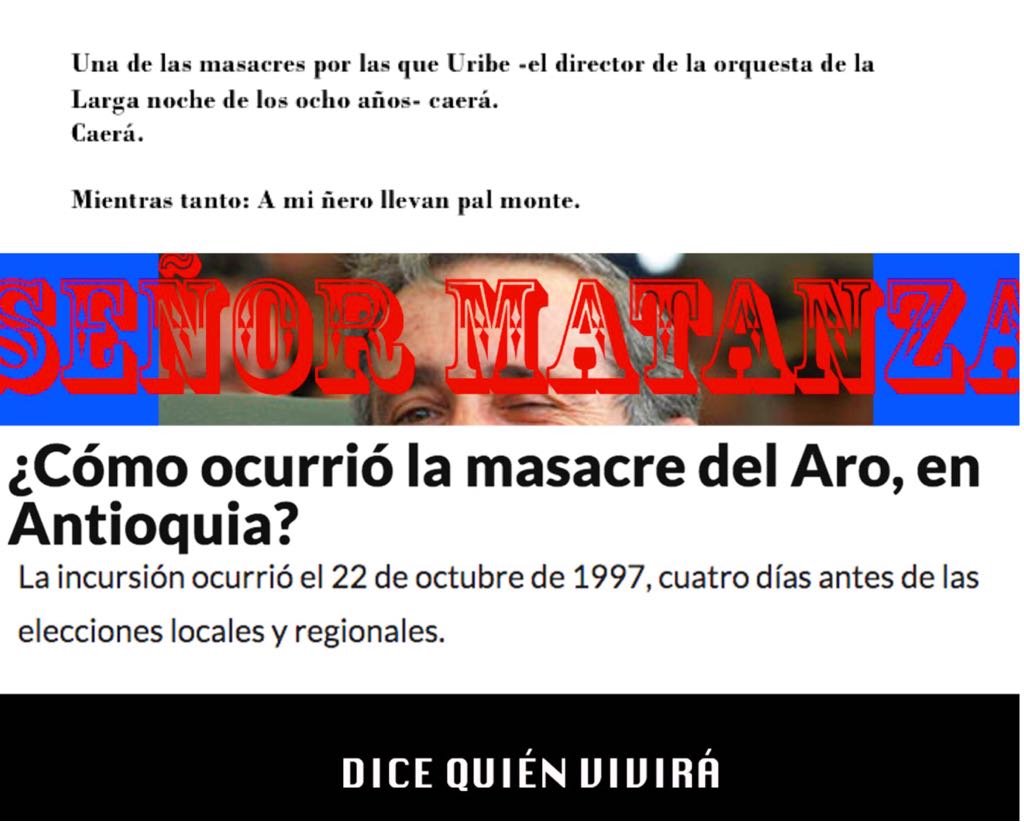
SEÑOR MATANZA [1]
COLOMBIA DOESN’T WANT YOU
THE WORLD EITHER
Historical Context of ‘Señor Matanza’ in Colombia
Jimena Andrade, Victoria Argoty, Daniel Castellanos, Camila Cifuentes, Miguel Estupiñán, María Gamarra, Guerthy Gutiérrez, Susana Lyons, Silvia Valderrama, Esthefanny Yague, Nicolás Vargas.
In order to understand the difficult moment that Colombia is living today, it is necessary to give a brief review of the untold history given by the hegemonic narrative, and to narrate the stories of those who are above in power. Let’s start from the results of the presidential elections on May 28th, 2018 in which: Iván Duque was granted the title of next ‘President of the Republic of Colombia’, thanks to his appointment as a candidate for the ‘Centro Democrático’ – Democratic Center from the ex president Álvaro Uribe Vélez. Duque won with a total of 54% of the votes, a number that corresponds to 10.369.210 people. Nevertheless, this presidential elections were historical for other reasons: This is the first time in Colombia where a candidate from a left party passed to ballotage, and even more, with so many votes (over eight million). To explain this phenomenon, there is an hypothesis that the peace treaty signed by the Colombian Government and the Revolutionary Armed Forces of Colombia – People’s Army FARC-EP (now disarmed, demobilized and legalized as a political movement) had an effect on that part of civil society that lived separated from the conflict, that didn’t recognize it in its entirety, and that was normally uninformed by mass media news. This results prove that little by little, people have become more aware and conscious about the conflict, and even though this has been a hard task, it is important to recognize that this collective state of mind now is better than the null conscience we use to have in the past.
Since its foundation as a Republic, Colombia have lived social strife: Social exclusion, racism and the enrichment of a few submitting the will of the majority is what has prevailed. To understand this conflict, we have to know our history, but as history is an exercise of power, we need to know the subaltern versions, which helps us removing the lenses and the influence that for decades and still today mass media have made by fabricating facts.
This unpublished history by mass media is instead narrated by some other brave people. Like the testimony in which this short summary is based, a report completed by Father Javier Giraldo S.J[2] for the Historical Commission regarding the Origins of the Conflict and their Victims[3], within the context of the peace dialogues between the Colombian government and the currently demobilized army FARC-EP. For this, Father Giraldo has located the origins of our conflict in the dispossession of lands, the impoverishment, the exploitation and the aggression of the elites against the population by generating violence of unforseen magnitudes towards thousands of victims. The author, focuses the problem in the inequitative land distribution policies that have been designed for territorial dispossession, which with the passing of years, have become more sophisticated.
Since the decade of the 1950’s, Colombian elites (represented by the State) reached a point of funding particular armies to exercise violence with the purpose of dispossessing entire communities from their lands through acts of extreme violence like massacres, and generating terror and displacements. The problem of the lack of access to the use of land, which supplies three of the basic human necessities (food, work and shelter), has been the principal trigger of the Colombian conflict. This issue starts in the Republican era and the adjudication of vacant lots to a few landlords (protected by law) with the purpose of turning the land into merchantable individual properties. Due to the aforementioned facts, is that indigenous peoples were dispossessed from their safeguarded territories, in return, they were forced to become laborers, aparceros, renters, pawns, etc.
During the period from 1880 to 1925, the original settlers pacifically and legally fought back, claiming to the authorities about the abuse of the squirearchy, but they lost. Before 1920, indigenous peoples led by Manuel Quintín Lame rebelled and stopped paying imposed obligations for their usurped lands. And so, they invaded uncultivated areas of farms and for this reason, they were prosecuted, tortured and criminalized. In 1936, the 200 Law of Lands, aimed to limit the extensive and unproductive lands, as well as to arrest all forms of exploitation to the workforce. This had a reverse effect on the landowners whose response, was to kick out the labourers from their farms and provoked a rural exodus to the cities in the decades of the 30’s and 40’s.
The fight for land got all mixed-up and became aggravated by the hatred of opposing political parties’ (fed by an anti communist ideology that prevailed in the government and the parties that controlled it) got incentivated by the Spanish Civil War and by the even stronger incidence and control of the United States, dragging the country to barricade militantly in the Cold War, by the simultaneous influx of Franco’s Falangism in some political leaders, and by the strong force of the Catholic Church’s ideological crusade with an undeniable influx in one of the parties against socialism, communism and liberalism. Nonetheless, in between many intersecting factors of violence, the most objective factor, if we analyze the real life conditions of the people and the one finally projected in a classist armed insurrection, is the problem of the access to land (Giraldo 2015, 420-21).
The deaths, forced displacements and abandoned parcels were more intense during the era called ‘The Violence’ (1948-1958), a bloody civil war heated up at the center of the traditional political parties, the State and the church itself, which (at a local level) took the shape of inequalities sharpening the conflicts for the access of land, the meeting of bare life conditions and the positions of power within the government. This aforementioned agents, locally and through time, would gradually intensify the conflicts that we are currently living in, and now they feel at risk by what was treated with the signing of the peace accords.
One first precedent of the deceit that the state has perpetrated against demobilized actors happened back in 1953, after the ‘soft stroke’ or ‘golpe blando’–in Spanish where General Gustavo Rojas Pinilla started a period of negotiation and signature of amnesties to the liberal guerrillas in an attempt to stop the slaughtering of the population. After this settlement, one one of the most emblematic guerrilla leaders, Guadalupe Salcedo Unda was killed in 1957 by the police as part of the elimination of the demobilized guerrilla leaders that started right after the non-compliance with the agreements that caused him to abandon the armed fight in the first place.
After General Pinilla’s period, ‘The National Front’ shaped the way the Colombian state took in order to deal with the conflicts between the elites and to ease the the reigning civil war. By establishing an alternation in the Republic’s presidency, exclusively for the two traditional parties: Liberal and Conservative, this exclusionary model meant persecution for any political alternative (the Communist party was declared illegal during this period) and so, it was the fuel instead of the remedy for the violence caused by the usage and ownership of land. This reason eventually lead ‘The Southern Block’ of the Communist party to turn itself into the Revolutionary Armed Forces of Colombia – People’s Army FARC-EP.
To understand this establishment of the FARC-EP, since the 50’s (before the disputes for the land and the abuses of the farm owners protected by the government of that time) a movement of peasants started to organize themselves in order to resist those who persecuted, tortured, criminalized, expropriated and stigmatized them mediatically with the name of the “independent republics”. Before ‘The National Front’, many of these guerrillas were constituted by the order of the ‘Liberal Party’ considering that in their foundations, there were seeds of communist proposals or ideas. This organizations (squalidly armed) were ferociously attacked by the army on that same year, with a military invasion to Marquetalia, Tolima. This attack will be permanently written in history as one of the biggest mistakes perpetrated by the state because it became another reason to create the guerrilla armed movement FARC-EP and the Worker’s Self Defense or ADO and their struggle option for achieving power by rising up in arms was justified explicitly in “the impossibility of finding reforms by the legal paths or any political activities” (Giraldo 2015, 16).
In January 1974, a new insurgent structure emerges: ‘The Movement of 19th of April’ or M-19, which justified its struggle with the electoral fraud of the 19th of April 1970, proving to its members that the elections are not the path towards power. The murder of 50 people that were rallying at the civic strike of the 14th of September 1977 revealed the existence of another armed structure called the ADO. This organization retaliated this murders by killing the former Government Ministry. Later, in the 1980’s, new insurgent structures appeared among them, the indigenous established Comando Quintín Lame (Quintín Lame Command), whose struggle was justified by the brutality of the military actions against the land recovery from the indigenous reservations and the murder of the indigenous priest Álvaro Ulcué, acknowledged indigenous leader from the Nasa ethnic group (Giraldo 2015, 16).
The triumph of the Cuban Revolution definitely gave a boost to the popular uprisings and to insurgent armies that quickly flourished in the seventies; however, in Colombia they merged with peasant guerrillas with affiliation to the Liberal Party and afterwards, they were abandoned by the party and prosecuted by the government after the establishment of the National Front.
After the seventies, the scenario became more complex due to the drug trade boom in the sixties. This triggered the United States to start monitoring the conflict and to orientate it towards counterinsurgent warfare. In the meantime, the guerrilla and the coca workers, united on their struggle against the state. That is why some insurgencies started to be financed by the drug trade under the modality of taxes per gram of the alkaloid, which established some kind of order within the regions in accordance with the communities. Then in the seventies, human migrations were articulated in order to occupy empty land with insurgent groups to cultivate crops for illicit use. Then in the eighties, drug trade merged with the paramilitaries and then, massacres started occurring, massive population dispossessions and land usurpation became common, even today this situation has not halted. That is why the paramilitary phenomenon, as a state project, has had a vertiginous and unprecedented escalade since the eighties.
Paramilitarism was not created (as it is believed) under the umbrella of the drug trade in the eighties: it started with counterinsurgent dynamics commanded by the United States since the sixties. In 1989, this paramilitary phenomenon meant to be constitutionally illegal in the government of Virgilio Barco, but was legalized rapidly through different legal processes since 1994 until 2005. In addition, this created a network of snitches and cooperators that still runs in the national territory.
State relations with society through time have deteriorated in the absence of guarantees of compliance with basic rights and coexistence. This enabled that thousands of social leaders and human rights defenders to be assassinated, and their murders to remain in absolute impunity. Also, basic needs of life and means of coexistence such as information, participation and protection have been constantly violated. The impact of this on Colombian society have been expressed in the assassination of thousands of leaders. While fighting for justice becomes a potentially deadly activity, it excludes socially and politically those who resist and fight. To add up, there is a huge corruption of the electoral apparatus and the truth is absolutely co-opted by economic, political and social conglomerates by manipulating opinion through mass media, reproducing and fostering of a visceral aversion to any form of dissent or rebellion.
After facing all this state’s injustices and absolute abandonment of the majority of its submitted subjects; the right of rebellion can be claimed. Father Giraldo gives a legal foundation to the right of rebellion by legitimizing it through important moments throughout human history such as the declarations of independence, the French revolution and the human rights declaration, where it appears to be a determining fact for other rights to be consistent. Through time, this right to rebellion started to be transformed by international political pressures with a hearing at the United Nations and disappeared from the Universal Legal Framework turning it into terrorism.
Reference list
Giraldo Moreno, Javier S. J. 2015. “Aportes sobre el origen del conflicto armado en Colombia, su persistencia y sus impactos”. In Informe de la Comisión Histórica del Conflicto y sus Víctimas. Colombia. Office of the High Commissioner for Peace.
Food and Agriculture Organization for Latin America and the Caribbean. FAO April 5, 2017. “América Latina y el Caribe es la región con la mayor desigualdad en la distribución de la tierra”. http://www.fao.org/americas/noticias/ver/es/c/879000/
[1] ‘Señor Matanza’[Mr. Slaughter] is the name of the collective which at the same time, refers to all the network of politicians, desinformation of the mass media and economic groups that sponsor violence, hunger and poverty. Also, is the name of a song performed by Mano Negra.
[2] The Jesuit Father Javier Giraldo is one of the most respected people in Colombia for turning into the voice of the vulnerable people. He is one of the bravest human right defenders in our country. As a priest and as a citizen, his political approach comes from the Liberation Theology, which is highly persecuted by the Catholic Church. Facing the corruption of the Colombian judiciary, he decides to use the available legal tools to denounce the excessive use of the power from the military forces and the irregularities committed by illegal groups, especially the paramilitaries over the communities. http://www.javiergiraldo.org. The words and work of Camilo Torres Restrepo in 1965, trigger Giraldo’s life option as they thrive for the truth, as they work towards a real shift in the structures of society and justice; however, it is really at the beginning of the eighties, when paramilitaries and drug dealers from the Middle Magdalena Region that he starts his labor and assume the direction of the ‘Centro de Investigación y Educación Popular / Programa por la Paz - CINEP-PPP’ (the Center for Research and Popular Education/Peace Program) http://www.cinep.org.co/, foundation that works for the systematization of information related with the Colombian armed conflict, the peace, the social struggles and the protection of the integral human rights. With the help of witnesses, he creates the Human Rights and Political Violence Database ‘Noche y Niebla Magazine’ https://www.nocheyniebla.org gathering non-judicial information about the crimes against peasants, civil and human rights defenders, and activists from the UP – Unión Patriótica (Patriotic Union). With the help from representatives from catholic background and human rights defenders, he founded the CIJP – Comisión Intercongregacional de Justicia y Paz (Inter-Church Justice and Peace Commission) whose objective was to visit regions where massacres took place in order to safeguard and share the victims’ memory. Created in 1997, the peace community of San José de Apartadó http://www.cdpsanjose.org/ became one of Giraldo’s main battles; a peasant population declares itself neutral towards the armed conflict and rejects the presence of all armed forces in its territory.
[3] Available in:
http://www.altocomisionadoparalapaz.gov.co/mesadeconversaciones/PDF/Informe%20Comisi_n%20Hist_rica%20del%20Conflicto%20y%20sus%20V_ctimas.%20La%20Habana%2C%20Febrero%20de%202015.pdf
[4] (FAO 2017) http://www.fao.org/americas/noticias/ver/es/c/879000/